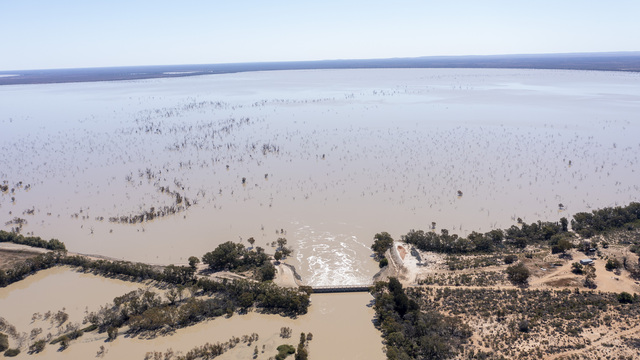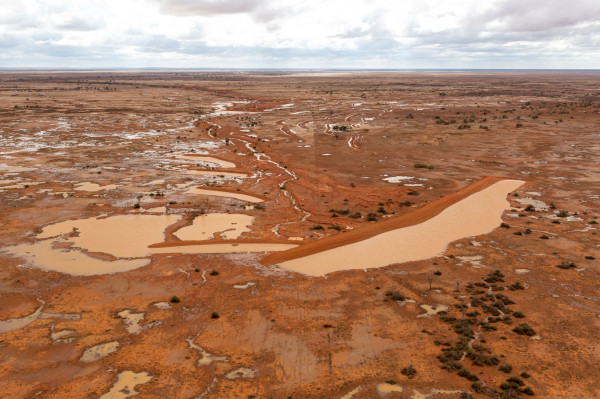
AN effort facilitated by Western Local Land Services is seeing the rehydration of formerly dry, arid pastoral stations throughout the Far West Region.
Senior land services Officer for the Rangeland Rehabilitation Project, Paul Theakston, has been visiting station properties throughout the region to formulate site-specific plans to redirect ineffective water flow and improve soil quality.
“Basically what we’re looking at whenever you have erosion in the landscape, is that the erosion takes water off the land really fast,” he said.
“We’re trying to stop the water from washing it away, keeping it on country, or rehydrating.”
Mr Theakston said erosion has formed gullies on properties that cut deep into the soil’s surface and don’t allow water to flow across the surface, but rather down these erosion gullies or ‘drainage lines’.
“As soon as the erosion happens it cuts down into the drainage line, so the soil is being cut away and you have a gully,” he said.
“So with an erosion gully it’s not spread out over the landscape anymore. It’s something that normally would have sat on top and it’s now not able to spread out into a wetland. It’s basically a drain.”
While that erosion is a natural process, Mr Theakston said things like agricultural practices can affect the rate of degradation.
“There are two main causes: sort of a track, such as where a car going over a bit of ground, lowering the land surface, but also if country is overgrazed, the water runs off it like a concrete slab,” he said.
“It just can’t absorb in the same way because it’s not nutrient rich, the overgrazing takes away that spongy layer of the soil surface.”
Mr Theakston said grazing isn’t only applicable to just sheep and other livestock, but also to native animals like kangaroos.
“Kangaroos are a massive grazing impact out here, so a landholder has to manage the native animals and also their own animals like sheep, cattle,” he said.
“Then there’s also feral animals, like feral goats.”
To redirect water flows to be able to rehydrate the top layer of soil, often earth-moving machinery is required.
“You have to put in banks to divert water away from these erosion gullies and spread it, to create that original meandering flow,” Mr Theakston said.
“So instead of water going straight down a gully and out of the system, you sort of make these banks with graders or bulldozers, and then you can kind of recreate that sheet flow again.”
Mr Theakston said concern over soil erosion and loss of nutrients has existed in the area for at least 80 years with the creation of a government department called the Soil Conservation Service researching the topic as early as the 1930s.
He believes lots of the original erosion gullies and damage came about due to a drought at the turn of the 20th century.
“The big event that really stuffed it was the Federation Drought, which happened in the late 1890s and early 1900s.”
The role of rangeland rehabilitators like Mr Theakston is essentially to engage with landholders and formulate a plan to redirect water that is specific to their property.
“What we’re doing is looking at the best country on the property, and we go okay, what’s threatening it?” he said.
“So the threat might be an erosion gully, and we’ll want to stop that before it eats into the really good country. That’s what we look at first, and then we move on to the really degraded, eroded country.”
Mr Theakston said his goal is to recreate what existed there before erosion occurred.
“The benefits are environmental as well as agricultural,” he said.
“You can have benefits to both on the same parcel of land. If you’re creating a healthy ecosystem, it’s healthy for grazing, but also for the environment, whether it’s plants or animals. It’s called a dual outcome, and the dual outcome is agricultural productivity and environmental benefits.”
Mr Theakston said erosion also threatens to destroy Aboriginal Artefacts and cultural sites, so a lot of his work involves stabilizing landscapes to preserve these cultural sites.
“We engage a local aboriginal person to go and look at the area, so that we can ensure we protect cultural sites at the same time, so we’re working together to achieve three outcomes.”
Mr Theakston said the response from landholders has been overwhelmingly positive.
“It’s not 100% about it being agricultural, landholders love seeing the environmental benefits too.”