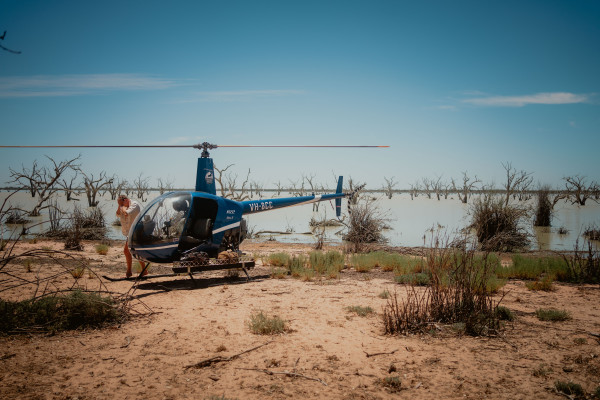
AS the sun rises over plains of Outback shrubbery on a remote station some hundred kilometres from Ivanhoe, Louis Bennell steers his two-seater helicopter into an almost vertical drop towards the earth.
This technique, colloquially referred to as “bombing”, is the best way to push stubborn stock from their hiding places to herd them into the direction required.
The helicopter has no doors and Mr Bennell’s Mini Fox Terrier dog and co-pilot, Neville, sits unfazed by the sudden movements of the helicopter or the lack of doors.
“Don’t worry, he won’t fall out,” Mr Bennell said.
Today Mr Bennell is rounding up thousands of goats from the air, radioing in to a team of ground crew on bikes and buggies who work collaboratively to find and move as many animals as they can towards a smaller paddock, where they’ll be packed into trucks and sold.
Up in the sky, Mr Bennell has the benefit of a clear birds-eye view over the property below that ground crew aren’t afforded amongst the scrub.
Herding animals from the air through use of sound, smoke, and occasionally ‘bombing,’ seems like second nature to Mr Bennell, who calmly throws the aircraft around with ease.
Yet just over a decade ago, Mr Bennell was living in inner-Western Sydney, completely unaware that helicopter mustering even existed.
The first he learned of mustering was when he hitched a ride with an old cowboy as an eighteen year old teenager looking to escape the suburbs.
“I was getting into trouble with the police, so I thought I’d better get out of Sydney, so I don’t end up in jail,” he said.
Mr Bennell was given a ride by a man called Darcy Richards, who offered him a job on the condition he was willing to learn to ride a horse, work cattle and do some fencing.
“I didn’t know this bloke, I didn’t know where I was going, but I ended up on his farm,” Mr Bennell said.
“I had no experience riding horses or bikes, I didn’t have a clue what I was going.”
Mr Bennell said the first time he got on a horse he knew it was where he was supposed to be.
“As soon as I got on the horse, I thought it was the best thing ever, the thing I needed to be doing,” he said.
After eight months of working on the farm, Mr Bennell decided to try his hand at similar work even more remotely in the Northern Territory.
“I went up there thinking I was pretty deadly because I’d done eight months on the station,” Mr Bennell said.
“Then I got up north to the NT and realied how useless I was. Tougher horses, tougher cattle.”
Mr Bennell spent a couple of years working in the Northern Territory, but said he considered quitting mustering at times due to the difficulty of the job and landscape.
“In the early stages of my career there were many moments where I questioned if I was cut out for the sort of work I was doing,” he said.
“I thought this is too much for me, I need to go home.”
But Mr Bennell persisted, later taking a job working in Townsville at a live export cattle yard.
“I was sitting there doing a crossword one day and my operations manager of the live export company asked me if I had a passport,” he said.
“And I said I didn’t but that I could get one. Within two weeks I was sailing on the world’s largest livestock carrier.”
With Mr Bennell’s mustering background, he was employed to essentially to supervise cattle.
“My job was pretty much looking after the health and welfare of the animals,” he said.
In his time off between trips at sea, he worked with a friend catching crocodiles in Darwin.
“We had traps, we’d hang a pig leg on some cable, they’d pull the leg, the gate shuts behind them,” he said.
“Then you have to open the gate up front, get the rope around them and pull them out.”
Mr Bennell said often he’d find himself face to face with a crocodile, thinking that if it had wanted to kill him, it probably could.
After a few years working for live export ships and occasionally catching crocodiles, he decided to get back into ringing work, this time in the Pilbara.
“I was still doing the boats a couple of times a year,” he said.
“And working in the Pilbara for three years. I saved a little money from the live exports to do my helicopter license.”
He completed his helicopter pilot’s license between Sydney and Orange and had his first job chopper mustering in the Pilbara.
During COVID, he travelled to Broken Hill to visit a friend who was teaching but became trapped in town by border closures.
“I couldn’t get back up north, so I decided to go underground which is where I met Johno,” he said.
‘Johno’ (Alex Johnson) and Mr Bennell decided to pool their money together, which afforded them a 10 per cent deposit on a helicopter to start their helicopter mustering business.
And so Far West Helico was born, offering mustering by air services to the Far West Region.
Today, the business employs five pilots (including Mr Bennell and Johno,) and two ground crew, one occasional contractor and has a fleet of four two-seater pilots, with aims to this year buy their first four seater.
Mr Bennell splits his time between the office, working on the business side of things, and in the air, moving cattle and goats on remote stations like he is today.
Though the original adrenaline of flying has worn off since his early days of flying, Mr Bennell said he still loves spending time in the chopper travelling and mustering throughout the Far West.
Mr Bennell said when leaving Sydney in his youth, his only plan had been to escape.
Now he realises it served to set him on a path to find where he needed to be; a place he hadn’t even been aware existed at the time.
“When I left Sydney, I thought I was running away from something, but really I was just starting on my journey,” he said.
“Now I couldn’t imagine myself anywhere else, or doing anything else. And the exciting part is, there’s still plenty more to come.”